March 2019
What do you do? What sort of things do you make? Or select?
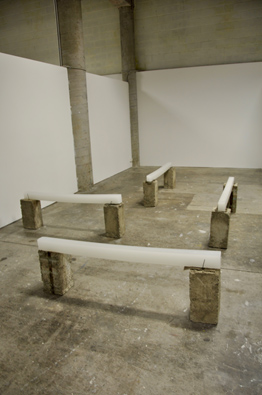
During daily travel, I collect objects I encounter which hold both a sense of strength and fragility and suggest to me that rather than being fixed, meaning and the future are indeterminate.
I use this material to create sculptural installations that bring found objects and discarded materials into conversation with various exhibition platforms. Situating material in new contexts is a means for me to interrogate structures of meaning, underlying systems of hierarchy and associations of value.
What is it that you have been trying to do to make the work relevant in relation to ideas, cultural circumstances or contemporary issues?
As an artist, I research, read and think critically about my practice and consider what impact if any my work may have on others.
Living in an era of extreme delicacy and fragility, global warming, threats of war and terrorism are just a few current issues which create feelings of uncertainty. We have entered a new epoch, the Anthropocene, which places human activity as the dominant influence on climate and the environment. I place my practice within this cultural context of limitless future potential, constant progress and the simultaneous making and unmaking of both natural and human structures.
I use my work to respond to the sense of uncertainty which pervades everything. Finding any state of stability is futile and unachievable. Although we attempt to build structures of control, physically, socially, politically and mentally, any security we gain is never assured or solid. Despite feeling uneasy, flux is positive as it gives constant opportunities to change current states of being.
Although these concepts are heavy, I don’t expect the work to carry the weight of the world. Instead, I intend it to be light and devoid of responsibility to provide answers. It exists to continue to ask questions and observe what we think we know. I like to think that my work could provide the space to think in unconventional ways and disrupt any singular, historical narrative.
How do you make decisions during the course of your work? How and why do you select the materials, techniques, themes you do?
My first decisions lie in choosing what to salvage. I am intrigued by the layers of meaning held in an object and their capability to develop a value beyond their originally intended purpose. Discarded materials are everywhere, but I don’t just select anything. The objects I collect contain some form of previous pattern, repetition or were used to define a boundary, although have gone on to physically represent freedom from this. I find myself drawn to subtle things which are often overlooked by others and were never intended to be viewed as art. They possess inherent sculptural, painterly or drawing qualities without trying.
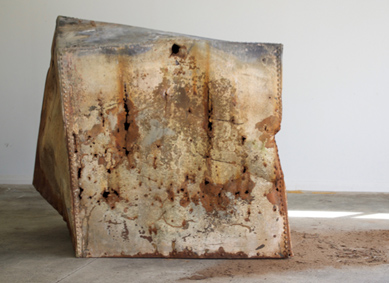
I shift the materials into my studio to trial methods of presentation. Each work has a unique individual history and materiality. Sometimes the site of collection holds an interesting conceptual hook I think is worth responding to and other times this has no significance so I let these details go. I make these decisions in relation to the specifics of space or the theme/title of where the work may be shown. I think a lot about the physicality of space, height, measurement, the grid, how the object feels in the space and how installation can physically manipulate the viewer. All of these details add conceptual layers to the work that I appreciate.
Sometimes I choose to make in response to a found object. I am interested in casting as a process. How the organic nature of the fluid material surrenders its freedom to become controlled and defined by the space it sits within. The form moves on to discard the mould of its making, while still carrying the trace of this former experience.
Why have you created the works you presented at seminar and what is its history?
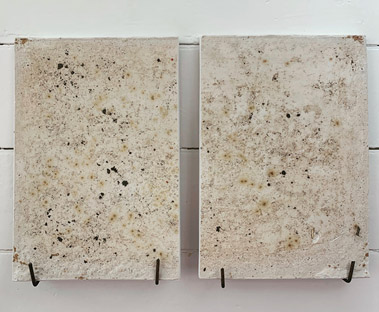
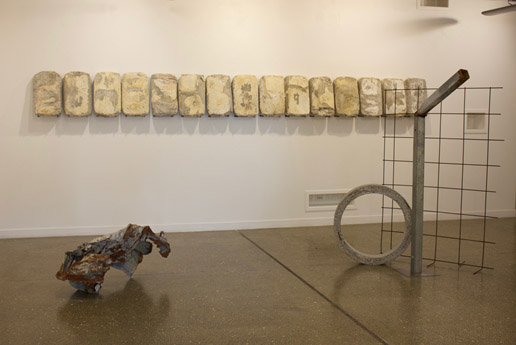
The works I presented during the seminar are discarded mundane, mass-produced multiples, formed through the process of industrial manufacturing. These materials are used to build the spaces we inhabit. They have developed an inimitable quality due to the conditions of their environment, this continues to develop over time.
Authorship may not be evident through the physical making of these found forms, however, it is present in the placement and context of the work. These objects retain traces of previous histories, relocating them in the gallery context allows them to be viewed from a more critical perspective.
What are you trying to say in the work? What are you valuing in the work?
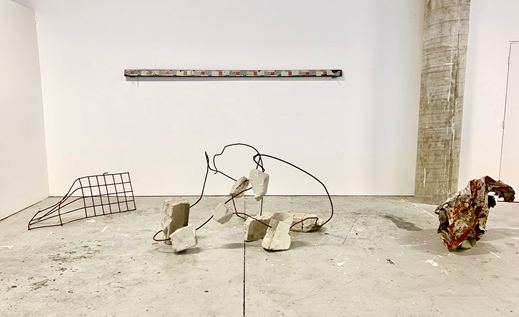
My artistic practice is sculptural as I enjoy the experiential capabilities of three-dimensional expression. It allows me to explore alternative perspectives both physically and conceptually. Moving in and around the work installed in a space, seeing it from different angles, allows viewers to appreciate the possibility of examining fresh perspectives too. These concepts are indicative of my intrigue in the way my mind attempts to understand, define and organise what I see. However, this remains temporary, as I keep reforming opinions.
I value my process. I used to be a perfectionist. I felt constrained by my role as an artist bearing sole responsibility for the outcome of the work. Until I realised mistakes and weaknesses were interesting and honest. This drove me to experiment with processes or materials which required me to relinquish control and allow results to occur naturally. This approach gives unseen forces a role in the production of the work. Not preconceiving outcomes leaves me open to being rewarded and surprised by unexpected results and removes full accountability from me.
Another part of my process that I value remains unseen. Interactions I have with the wider community. Asking owners permission to have their discarded materials is amusing. They are always keen to give these objects away, but also curious why I want them. I hope my work questions what it is they value, and consider the potential for previous values to change. This initial interaction is essentially the beginning of the work, even before it has reached its new site of display, as I consider my social exchanges part of the art which takes place outside the walls of the gallery.
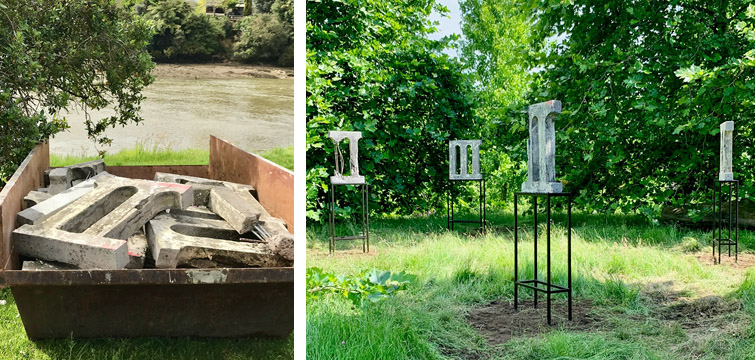
Fig. 5 (right), Permanent Installation Riverhaven Artland, Clevedon, Auckland, 2018.
How is the way you are saying it, with the materials, techniques, and themes, the best for the idea you want to present?
The current culture of mass production and excess results in a neverending supply of discarded materials. My process of collection responds to this environmental issue. It makes sense for me to utilize found materials, rather than producing something new as I couldn’t reproduce the character and history embedded inside these objects, they have an authenticity I respect. This enables me to reflect upon the vulnerable and delicate state of both ourselves and our environment by questioning value, convention, commodity, and waste and gives me complete freedom to experiment and explore without the pressure of feeling wasteful if results are unsuccessful.
Shifting found objects to a new site is a technique I use to demonstrate the instability of meaning. This dislocation alters the objects previous function and allows me to reconsider value.
I find working with liquid materials in moulds ideal for demonstrating the tension between order and chaos, containment and release.
All of the materials I use have been mass produced and many themselves the result of a casting process. They hold in their form notions of repetition which to me represents convention and conformity, however, the strength in this form has been compromised, lost its integrity, in essence, all things are vulnerable to constant change.
How does your current work relate to previous work?
I see current work and previous work not as separate, but part of the same mass with a central core or theme I explore. Different projects extend out from here in all directions, rather than moving in one linear direction of time, from start to finish. The relationship between past and current works for me is similar to kneading dough, it’s active, history and present, folding in on itself over time. This approach is influenced by philosopher Michel Serres.
What does change with each work are the objects I collect, their material qualities and the spaces in which they are shown. I consider their history and possible futures, this dictates how I respond to them. But past experience and past projects are
always naturally embedded in any new work. Sometimes I reuse materials or processes from past projects because I like the sense of them continuing on, never being complete or finished. I am investigating this at the moment with rust and dust particles obtained from previous works becoming embedded into new forms.
What influences your work?
I am highly influenced by how I relate to my current environment, not limited to where I physically stand but extends out into my community and into the wider world.
Space and the specifics of site further modify the work. I consider the constraints, rules, boundaries, and structures that define a site, and how crossing these thresholds informs our perception. Environmental conditions such as weather, time and geographical position also have some influence over how the work is experienced and also how it develops.
History is another influence on my work. Not just the history of sculpture, but the history of the objects I collect, the spaces they are shown and also my own history and experience. I’ve always had links to the construction industry which perhaps influences my use of materials. I take after my fathers love of concrete, as it can take the form of anything. He owned a concrete roof tile company which laid and manufactured tiles formed in concrete. My husband designs and fabricates steel windows. I appreciate the weight and substance of industrial materials, they command space, hold a sense of authority, substance, and presence.
What is your inspiration for your images?
I use discarded objects from contemporary society because I value them as forms, metaphors, symbols, and temporalities which exist in the specificity of here and now. Deciding what we choose to keep or what we discard is driven by underlying systems of hierarchy. These decisions shape not just our identity, but our world.
How does this work fit into a larger body of work or overarching project (if it does)?
My practice explores objects, the body, and experience in space. My works contain a presence of form but allude to an absence which is never far away. Identity, objects and the environment are all vulnerable forms undergoing constant change. John Caputo described this when he wrote: “what is really going on in things, what is really happening, is always to “come”. Every time you try to stabilise the meaning of a thing, try to fix it in its missionary position, the thing itself, if there is anything slips away”.1
I find it interesting to question what matters and what is valued? How do we find meaning and knowledge in a world of flux? Exploring these concepts has led me to realise instability is one thing that interconnects everything, it is in all and is everywhere. Like objects we are bodies of matter responding to the conditions of our environment, always evolving. I am learning to accept the inevitability of constant change in myself and my thinking and remain open to new directions and enjoying moments of unpredicted chance discoveries.
How did your idea change (if it did)? Or, how are your ideas changing? (if they are)?
I am starting to appreciate the potential of broadening my range of exhibition platforms. I enjoyed the challenge of completing my outdoor sculpture commission last year. I found it interesting to consider how my work fits into traditional notions of ‘permanent’ outdoor sculpture, particularly considering impermanence and constant deconstruction are concepts central to my practice. Someone is essentially paying for the piece to gradually waste away and decay. As a result, my ideas are changing around how spaces other than the gallery can inform the work by creating yet another layer of conceptual interest.
Another issue causing me to rethink and change my ideas is that working solely large scale limits my ability to show in smaller spaces. Having a range of works in varied scale would be beneficial. I recognised this as I struggled to find work for an exhibition this year I was involved in titled Small Works For Small Spaces.
Has anyone done this kind of work in the past?
Historically sculptural work using heavy materials was predominantly the domain of male artists such as John Chamberlain, Richard Serra, and Anthony Caro. I respond to the reduced form of Minimalist art. Particularly Robert Morris who examined ‘Antiform’, which embraced chance and the potential of gravity to influence materials and shape the results of his installations.
Using found materials in my practice follows Marcel Duchamp who asserted the artists right to use ‘readymade’ objects as art. Arte Povera and Mono-ha movements also used a range of found materials in installations to create a dialogue between the natural and man-made.
Robert Smithson investigated the concept of ‘Non-site’, gathering raw materials from specific mapped locations outside and installing them in the gallery. Rather than the materials being viewed as isolated objects, they were displaced, simultaneously tied to the site of their collection outside the gallery walls. Taking fragments from the outside environment allows my studio practice to have a direct connection to the wider world. This concept of ‘Non-site’ and its influence on my work is an area I wish to research further.
Does anyone else do it now? Who are the artists that occupy this terrain?
I am inspired by the work of Carol Bove (b1971), a New York based sculptor who examines space and forms of display.
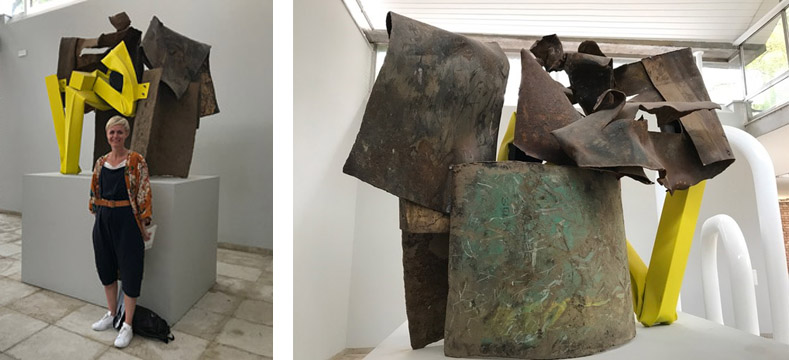
Figure 9. (right) Carol Bove, Detail Woman of Venice, Venice Biennale, 2017
I saw her installation at the Venice Biennale in 2017. In relation to the size of your body, these sculptures feel imposing. Although they are created from heavy steel, this becomes cleverly juxtaposed with a delicate lightness of form. They are rich in texture as Bove applies thick layers of brightly coloured matt paint which gives the steel the texture and appearance of rubber, while other parts are highly glazed. The painted forms are paired with torn, twisted, rusty sheets of steel and all bolted together to form large three dimensional collages.
After studying her work in books and online, nothing can compare to being in the same space with them, experiencing them. To walk around and appreciate the varied angles of perspective and detail available in each piece.
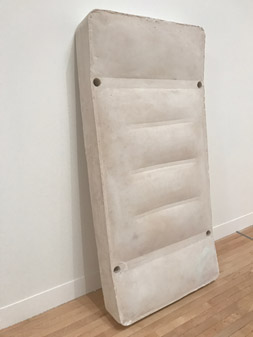
Rachel Whiteread (b1963) is a British sculptor who casts the space in and around common objects and spaces of domestic life. This process is a technique for her to represent one-off forms which hold traces of individual history. Using industrial materials such as resin, concrete, and plaster she sees “casting as a liminal practice that straddles the world of both objects and bodies”.2 I saw her retrospective in London recently. Seeing the works in person allowed me to experience a strong ghostly presence, an eerie sensation of something missing. This present absence of the ‘trace’ gave the exhibition real experiential power.
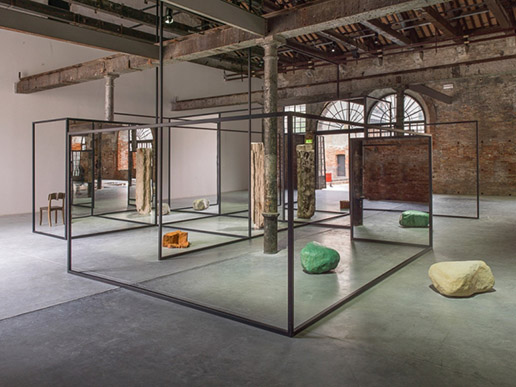
Alicja Kwade (b1979) creates large scale sculptural installations which employ everyday objects and basic physics and forces, to playfully re-examine our familiar reality. She is interested in time, reflection and perception. I saw this work also at the 2017 Venice Biennale. She placed cast doubles in mirrors at corresponding angles, these became activated by the movement of the viewer. I enjoyed the way this installation manipulated my physical sense of space, highlighting the constant instability of my present moment experience.
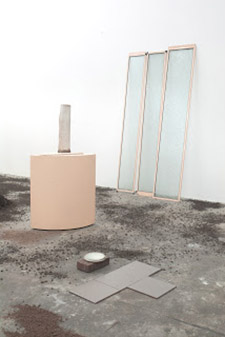
Eve Armstrong (b.1978), is a New Zealand artist who collects waste, reconstructing it into mixed media installations. Her practice investigates recycling and the value of bringing objects and ideas back into circulation.
Sometimes her work takes the form of a trading table where ideas and skills are shared. It is a money-less social exchange removed from the norms of a consumer-driven system. It becomes less about the trade and more about engaging in thinking and conversations around currency, worth and exchange value. I appreciate this lighthearted way of examining traditional thinking and exploring new ideologies.
Who are the writers on these subjects? What specifically have they said, which motivates your own thinking for your work potentially?
I am informed by recent philosophical theories such as Object Orientated Ontology and NewMaterialism. I am interested in the relational aspect of these philosophies, and their consideration for the capacities of non-human or inanimate matter. I find it interesting to reconsider our traditional anthropocentric views and contemplate a more ecocentric position.
I have just started to research New Materialism, which explores dissonant relations between natural and social worlds. I am currently reading Vibrant Matter by Jane Bennett, I relate to her thoughts, as I see a connection in the materials I collect and myself. They react to the conditions of their environment in the same way I do, living a life. Bennett claims we are not separate from this vital materiality, that runs both through and alongside us, and that political events could change if we gave the force of things their due. To consider things like the weather, commodities, and metals not only having the power to impede human design and will but as having tendencies, trajectories or an agency of their own.3 I like the ecological possibilities of this nonhierarchical, horizontal form of thinking.
Karen Barad is also a New Materialist author who researches science, physics, and feminism for her post-structural, quantum theories. She said “there are no selves. The self is diffracted through time and being. Undoing of inside, outside. Matter is an infolding, an involution, touching itself. The past is never finished and the future is not what will unfold. The world holds, or rather is the memories of its iterative reconfigurings.”4 I reflect on these ideas as I make work. She is very passionate about the interconnectedness of everything, and I appreciate the way her research
looks for methods for the world to act more collectively to solve important issues.
I enjoy the plasticity of meaning and matter, the ability it has to continuously transform and reconfigure. However, traces of an objects previous function, remain present, even in their absence. This relates to the thinking of Jacques Derrida who proposed “that every so-called ‘present’ or ‘now’ point, is always being compromised by a trace, or a residue of previous experience, that precludes us ever being in a self-contained ‘now’ moment.”5 I like to play with the concept of ‘trace’ to provide a deeper conceptual layering in my work.
French philosopher Merleau-Ponty created a change in visual perception specific to sculpture. Rather than an isolated object, he saw sculpture as being a spatial intervention which is shared with the viewer. This thinking has encouraged me to push the connections between sculpture, space, and viewer. I see space as a form of materiality, I can sculpturally manipulate. Alex Potts adds to this discussion when he writes. “Looking at sculpture could be thought of as a distinctive kind of experience that makes us more acutely aware of the temporality lodged in our awareness of things, noticing the different aspects the work presents and the unstable, shifting sense we
have of its immediate appearance.”6
My practice is aligned with the philosophy of Michel Serres. He uses concrete metaphors to describe abstract thoughts of time and spatial relations. In conversation with Bruno Latour, Serres suggests time rather than linear can be thought of as crumpling, a multiple foldable diversity, like dough. It is active and when folded, distant points can suddenly become close.7
Is your field an established one or did you have to invent it? What are the histories you are contributing to?
Sculpture is an established field. It has a history of being associated with monumental works which preserved form. I am interested in temporal works which challenge historical notions, compliance, and question singular perspectives. These concepts and my use of found discarded materials contribute to various historical art movements.
The Cubist philosophy abandoned traditional values of the singular perspective in search of new ways of thinking. I employ deconstruction and construction to both uncover and create new layers of meaning.
Marcel Duchamp, who was part of the Dada movement, used readymade objects to challenge hierarchy, however, the readymade’s ability to shock via contrast with establishment art values has passed. I use readymades because I enjoy reconsidering the value, function, and status of discarded objects.
Arté Povera in Italy and Mona-Ha in Japan were both movements which explored non-traditional, everyday materials, both natural and man-made in ephemeral installations, to challenge and disrupt the values of the commercialised gallery system. My work continues to challenge these commercially-driven systems as I explore the ambiguity of value. I also relate to the pared-back aesthetic of these movements as they offer quiet contemplation of deeper ecological, social, and political issues I still consider relevant today.
Notes
- John Caputo, in Reynolds, J, “Internet encyclopedia of philosophy: Jacques Derrida”, accessed February 20, 2019,
https://newderrida.wordpress.com/2007/11/19/some-key-terms/ - Helen Molesworth, “Part Object Part Sculpture” Exh. Cat. (Columbus, OH: Wexner centre of arts, Ohio State University, 2005), p.211.
- Jane Bennett, “Vibrant Matter” (London: Duke University Press, 2010), p.vii.
- Karen Barad, “Undoing the Future” Lecture presented at Roslyn Silver ’27 Science Lecture, Barnard Centre for Research on Women, New York, March 19, 2018, https://www.youtube.com/watch?v=bMVkg5UiRog
- Jack Reynolds, “Internet encyclopedia of philosophy: Jacques Derrida”, accessed February 20, 2019, http://www.iep.utm.edu/derrida/
- Alex Potts, “The sculptural imagination: figurative, modernist, minimalist”, (London: Yale University Press), p.219.
- Michael Serres and Bruno Latour, “Conversations on Science, Culture and Time”, 1995, Time Documents in Contemporary Art. Ed. Amelia Groom. (London: Whitechapel Gallery, 2013), p.164.

 Mel Arnold